Anemia is one of the most common — yet long underestimated — complications of diabetes. Analyses based on clinical databases show that the incidence of anemia is significantly higher in patients with diabetes than in non-diabetic individuals, and its prevalence even exceeds that of classic complications such as diabetic nephropathy, cardiovascular disease, neuropathy, and retinopathy, ranking first among all diabetic complications. The traditional view holds that diabetes-associated anemia mainly stems from insufficient erythropoietin (EPO) secretion due to diabetic nephropathy, nutritional deficiencies such as iron and vitamin B12/folate, and shortened red blood cell lifespan caused by hyperglycemia and chronic inflammation. However, a long-standing clinical puzzle remains: in a considerable proportion of diabetic patients with anemia, EPO levels are not low but are even compensatorily elevated, while iron metabolism and vitamin indices show no obvious abnormalities. This suggests that behind diabetes-associated anemia there likely lies an undiscovered hematopoietic-intrinsic mechanism.
Recently, a research team led by Qiao Wu and Hang-zi Chen at Xiamen University, together with Xuejun Li and Caoxin Huang's team at the Diabetes Institute of the First Affiliated Hospital of Xiamen University, published online in Blood a paper entitled “Nuclear Receptor Nur77 Orchestrates Hematopoietic Lineage Commitment to Avert Anemia in Diabetes.” Integrating clinical cohorts with multi-omics technologies including single-cell transcriptomics, ATAC-seq, and CUT&Tag, the study reveals for the first time that the orphan nuclear receptor Nur77 (NR4A1/TR3) suppresses diabetes-associated anemia by maintaining the lineage commitment balance of hematopoietic stem/progenitor cells (HSPCs). The authors propose a novel pathogenic mechanism in which diabetes-associated epigenetic modifications act synergistically with loss of Nur77 function to drive myeloid-biased differentiation of HSPCs, providing a new molecular target and theoretical basis for the intervention of diabetes-associated anemia.
To identify key regulators of diabetes-associated anemia, the research team first integrated multiple independent single-cell transcriptomic datasets (covering peripheral blood and bone marrow samples from patients with type 1 and type 2 diabetes) to systematically resolve the transcriptional landscape of HSPCs. They found that Nur77 was consistently and significantly downregulated across all datasets; Nur77 was most highly expressed in hematopoietic stem cells (HSCs) and progressively declined along lineage differentiation and with diabetes progression. Functionally, in three diabetic mouse models — db/db (type 2), high-fat diet combined with streptozotocin (HFD/STZ, type 2), and streptozotocin (STZ, type 1) — Nur77 knockout induced anemia, accompanied by splenomegaly and red pulp expansion indicative of extramedullary hematopoiesis; in contrast, non-diabetic Nur77 knockout mice showed no anemic phenotype, indicating that the pathogenic effect of Nur77 deficiency requires the diabetic background. Notably, diabetic Nur77 knockout mice exhibited increased rather than decreased serum EPO levels, with no significant abnormalities in iron, total iron-binding capacity, vitamin B12, or folate indices — essentially excluding EPO deficiency and malnutrition as the dominant causes at the etiological level. Critically, bone marrow transplantation experiments showed that transplanting HSCs from diabetic Nur77 knockout mice into normal recipients was sufficient to induce anemia in the recipients; whereas transplanting HSCs from wild-type or diabetic (Nur77-intact) donors rescued the anemic phenotype of diabetic recipients. This demonstrates that the determinant of diabetes-associated anemia lies in the cell-intrinsic state of HSCs, rather than in sustained exposure of the bone marrow microenvironment to hyperglycemia.
Mechanistically, the team first confirmed that Nur77 is predominantly localized to the nucleus in bone marrow cells. By generating DNA-binding-deficient Nur772CG (C287G/C290G) knock-in mice, they showed that this mutant fully recapitulated the anemic phenotype of Nur77 knockout under diabetic conditions, indicating that the transcriptional regulatory activity of Nur77 is critical for its anemia-suppressing function. CUT&Tag-seq confirmed that Nur77 directly binds to the promoter regions of key myeloid differentiation genes, including Fos, Cebpa, Egr1, and Klf6, and represses their transcription. Single-cell trajectory analysis showed that loss of Nur77 markedly increased the probability of HSCs committing to granulocyte-macrophage progenitors (GMPs), while differentiation toward megakaryocyte-erythroid progenitors (MEPs) and common lymphoid progenitors (CLPs) was impaired; colony-forming assays further confirmed increased granulocyte/macrophage colonies (CFU-GM) and reduced burst-forming unit-erythroid (BFU-E) and mixed colonies (CFU-GEMM) — that is, erythroid output is squeezed out by myeloid expansion. On the other hand, the diabetic state itself induced enrichment of activating histone modifications such as H3K27ac and H3K4me3 at the promoters of the aforementioned myeloid genes; this process was driven independently by the diabetic environment and did not depend on Nur77. ATAC-seq analysis showed that diabetes and Nur77 deficiency exerted additive effects on promoting chromatin accessibility. Based on these findings, the team proposed a “double-hit” model: diabetes elevates the expression baseline of myeloid differentiation genes through epigenetic reprogramming, while Nur77 deficiency further relieves transcriptional repression; the two effects combined push the expression of these genes beyond the threshold required to maintain hematopoietic homeostasis, ultimately driving myeloid-biased differentiation of HSPCs with insufficient erythroid and lymphoid output, leading to anemia.
Given that Nur77 has a clear protective role against diabetes-associated anemia, could pharmacological activation of Nur77 serve as an intervention? Heterozygous db/db; Nur77+/− mice displayed an intermediate phenotype between wild-type and knockout mice, suggesting that the protective effect of Nur77 is gene-dose dependent. The team treated such mice with the Nur77 agonist Csn-B: Csn-B significantly upregulated Nur77 expression in HSPCs, improved peripheral red blood cell counts and hemoglobin levels, corrected compensatory erythroid hyperplasia in the bone marrow and abnormal HSC/HPC ratios, and reversed the myeloid/lymphoid imbalance. More importantly, this therapeutic effect was completely abolished in Nur77 knockout mice and Nur772CG mutant mice, confirming that the action of Csn-B strictly depends on the transcriptional regulatory function of Nur77 — thereby providing stringent genetic evidence supporting the feasibility of targeting Nur77 for the prevention and treatment of diabetes-associated anemia.
Finally, the team collected peripheral blood from healthy volunteers, diabetic patients without anemia, and diabetic patients with anemia, and sorted CD34+ HSPCs for validation. The results showed that Nur77 mRNA levels in HSPCs from diabetic patients with anemia were significantly lower than those from non-anemic diabetic patients and healthy controls, and that Nur77 expression was significantly positively correlated with red blood cell counts (RBC) and hemoglobin levels (HGB); the myeloid differentiation genes FOS, CEBPA, EGR1, and KLF6 were significantly upregulated in anemic patients and negatively correlated with Nur77 expression. Peripheral blood differential counts showed elevated proportions of neutrophils and monocytes and a reduced proportion of lymphocytes in diabetic patients with anemia. These results suggest that monitoring Nur77 expression in HSPCs may serve as a potential biomarker for early risk stratification of diabetes-associated anemia.
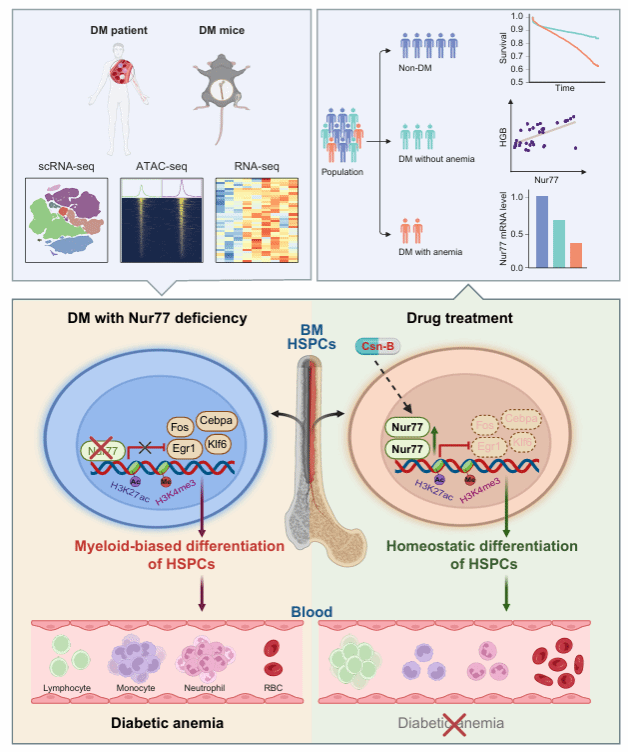
This study provides the first systematic mechanistic explanation of diabetes-associated anemia from the perspective of lineage commitment imbalance in hematopoietic stem/progenitor cells. Its clinical implications are twofold: for diabetic patients who remain persistently anemic despite normal EPO and nutritional indices, lineage differentiation imbalance of HSPCs should be considered; and because diabetes-induced epigenetic “metabolic memory” persists long after metabolic improvement, achieving glycemic control does not mean the anemia risk is resolved — dynamic monitoring of Nur77 levels in such patients may be of potential value. In addition, the myeloid bias of HSPCs may also be an important source of chronic inflammation and immune imbalance in diabetes; the applicable populations, therapeutic window, and long-term safety of Nur77 agonist intervention merit further exploration in future studies.
Hang-zi Chen (School of Life Sciences, Xiamen University), Caoxin Huang (Diabetes Institute, First Affiliated Hospital of Xiamen University), and Qiao Wu (School of Life Sciences, Xiamen University) are the corresponding authors of the paper. Postdoctoral fellow Qiao-ling Huang, doctoral student De-yi Feng (School of Life Sciences, Xiamen University), and Yinxiang Huang (First Affiliated Hospital of Xiamen University) are the co-first authors. This work was supported by the National Natural Science Foundation of China, the Natural Science Foundation of Fujian Province, and the China Postdoctoral Science Foundation.
Paper link: https://doi.org/10.1182/blood.2026034088
