Digital PCR (dPCR), with its absolute quantification and high sensitivity, has become an important tool in molecular diagnostics. However, its multiplexing capacity remains limited in “one-tube, multi-target” scenarios such as multiplex pathogen detection, post-transplant monitoring, and tumor mutation testing: current dPCR relies mainly on 5′-hydrolysis probes (e.g., TaqMan), with each target typically occupying one fluorescence channel, which increases reagent costs and sample consumption and prolongs turnaround time, severely restricting the application of dPCR.
On October 27, 2026, the team led by Prof. Qingge Li from the School of Life Sciences, Xiamen University, published online in the international journal Small a research paper entitled “Temperature-Resolved Coding for Highly Multiplexed Digital PCR Using MeltArray,” achieving highly multiplexed absolute quantification in a single reaction. The study proposes the digital MeltArray (dMeltArray) —a “temperature-resolved endpoint decoding” strategy. The team transferred their previously developed higher-order multiplex PCR system, MeltArray, to a static droplet imaging-based digital PCR platform, converting melting temperature (Tm) into a programmable readout dimension and thereby significantly enhancing dPCR multiplexing capacity without increasing fluorescence channels.
In principle, conventional dPCR distinguishes targets mainly by fluorescence color, whereas the core innovation of the dMeltArray is “temperature instead of color”: target-specific mediator probes are cleaved upon target recognition, releasing different mediator primers that extend on a universal molecular beacon reporter sequence to generate fluorescent reporter duplexes with preset Tm. After amplification, the same immobilized droplets are subjected to stepwise heating and endpoint imaging (e.g., sequentially at 50, 60, 70, and 80 °C). As temperature rises, low-Tm signals are progressively erased while high-Tm signals are retained; the positive-droplet fraction at each temperature is Poisson-corrected to obtain cumulative molecular concentrations, and the specific concentration of each target is then resolved at the population level by subtracting adjacent temperature states (Figure 1). The decoding order—“Poisson correction first, subtraction second”—is critical: the method requires neither target assignment of individual droplets nor real-time tracking or full melting-curve acquisition, thereby greatly simplifying the assay workflow.
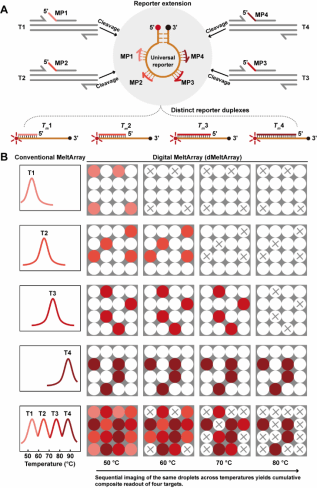
Figure 1. Cumulative temperature-resolved decoding in the digital MeltArray. (A) Mediator probes recognize T1–T4; cleavage releases MP1–MP4, which extend on a universal reporter to form duplexes with distinct Tm. (B) Single-channel four-target example: conventional MeltArray resolves targets by melting peaks (left); dMeltArray images the same droplets at 50–80 °C endpoints (right). Colored/white/crossed circles: positive/negative/erased droplets; shading: target identity. Poisson-corrected cumulative subtraction gives target concentrations.
Since all targets share a single set of universal reporter probes, the number of fluorescently labeled probes no longer increases linearly with the number of targets, significantly reducing reagent costs for multiplex detection. Meanwhile, the system allows primer and probe design and validation on conventional qPCR platforms before transfer to dPCR for absolute quantification, forming a convenient workflow of “qPCR development, dPCR optimization and application.”
Clinical proof-of-concept spanned two major scenarios: viral monitoring and liquid biopsy.
For post-transplant viral monitoring, the team constructed a 13-plex dMeltArray panel capable of simultaneously quantifying 12 viruses and the internal control GAPDH in a single reaction. The system uses only five universal fluorescent molecular beacon reporter probes labeled with FAM, HEX, ROX, Cy5, and Atto 425, distinguishing viruses by differences in melting signals at different temperatures. Testing of urinary cfDNA from 152 kidney transplant recipients showed that the dMeltArray results were highly consistent with those of singleplex hydrolysis probe digital PCR (TTV: Pearson's r = 0.9945; JCV: Pearson's r = 0.9964). Notably, co-infection with two or more viruses was detected in 74 samples (49%), fully demonstrating the practical value of multiplex monitoring with limited sample volume.
For tumor liquid biopsy, the team developed an 11-plex dMeltArray panel targeting 10 hotspot mutations in KRAS/BRAF plus the internal control RPP30, enabling accurate quantification across a VAF range of 5% to 0.005%. Mutation discrimination relies on Tm differences: mediator probes perfectly matching mutant sequences have a Tm above the annealing temperature, permitting probe cleavage and reporter generation, whereas probes mismatched with wild-type sequences have a Tm below the annealing temperature and yield no detectable signal. In 51 colorectal cancer FFPE tissue samples, the dMeltArray showed perfect sample-level agreement with NGS, correctly identifying 24 mutation-positive and 27 mutation-negative cases; in 8 matched tissue–plasma sample pairs, results were concordant with tissue status (4 positive and 4 negative pairs), including plasma samples with low-level mutations, validating the feasibility of the dMeltArray for liquid biopsy.
Another distinctive advantage of the dMeltArray is that its temperature-encoded signals can orthogonally coexist with conventional 5′-hydrolysis probe signals in the same optical channel: hydrolysis probe cleavage generates irreversible fluorescence that remains stable at high temperatures, whereas dMeltArray signals are erased above the Tm. On this basis, the team introduced an HSV-2 hydrolysis probe into the 13-plex post-transplant viral panel (HSV-2 identified by amplification curve; ADV and HSV-1 by melting peak Tm values), expanding detection capacity to 14-plex without adding optical channels. Comparison across 38 post-transplant clinical samples showed one additional HSV-2-positive detection, identical detection rates for the original 13 targets, and a paired positive measurement RMSE = 0.0533, with quantitative performance unaffected (R²≥ 0.9989 vs. singleplex dPCR).
In summary, the dMeltArray converts Tm from a conventional “identification parameter” into a programmable “digital encoding dimension,” providing a scalable route to high-multiplex detection without sacrificing the absolute quantification advantage of dPCR and without requiring full melting-curve acquisition or dedicated hardware. Moreover, the technology is compatible with existing hydrolysis probe chemistry, laying the foundation for a multidimensional dPCR system integrating “spectrum × temperature × probe signal.”
The first author is Xinqiang Chen, a 2025-entry doctoral student at the School of Life Sciences, Xiamen University; the corresponding authors are Prof. Qingge Li and Assoc. Prof. Ye Xu. This work was supported by the National Natural Science Foundation of China, the Guangxi Science and Technology Program, and the Xiamen Science and Technology Program.
Original article link: https://doi.org/10.1002/smll.76062
