CRISPR-Cas9 is an adaptive immune system of prokaryotic origin and, in its natural state, relies on dual guide RNAs—tracrRNA and crRNA—working together to achieve nucleic acid targeting. In 2012, the teams of Doudna and Charpentier fused the natural dual guide RNA into sgRNA through chimeric engineering; since then, sgRNA–Cas9 has become one of the most widely used and core foundational tools in the field of programmable gene editing. Meanwhile, through long-term antagonism and coevolution with prokaryotes, bacteriophages have evolved diverse immune evasion strategies, and a large number of anti-CRISPR (Acr) proteins have been found to inhibit Cas9 activity through different mechanisms. However, it remains unclear whether RNA-based Acr molecules targeting the CRISPR-Cas9 system exist.

On October 21, 2026, the team led by Liu Liang at the School of Life Sciences, Xiamen University, in collaboration with the team led by Yun Caihong at the School of Basic Medical Sciences, Peking University, published a research paper online in Cell Host & Microbe titled “A phage-encoded small RNA that mimics chimeric guide to inhibit CRISPR-Cas9.” The study reveals an anti-CRISPR RNA with a dual identity—rAcrIIA1: on the one hand, it can inhibit CRISPR-Cas9 activity by mimicking the structure of sgRNA, helping phages evade the host immune defense; on the other hand, it is itself a fully programmable guide RNA that can be used for gene editing and molecular diagnostics. This dual identity of being “both a brake and a steering wheel” overturns the traditional perception that anti-CRISPR RNAs can only serve as inhibitors, and also suggests that counter-defense elements evolved by nature over a long evolutionary arms race may simultaneously harbor tool potential that can be directly co-opted by humans.
Using bioinformatics approaches, the researchers identified an intriguing sequence within the genome of Streptococcus phage Javan584: its 5’ end is highly similar to the crRNA repeat region, while its 3’ end is highly similar to the tracrRNA template sequence, and it is immediately flanked upstream and downstream by an open reading frame encoding an anti-CRISPR protein. Small RNA sequencing subsequently confirmed that this region indeed specifically transcribes an approximately 111-nt RNA. To test its function, the team co-introduced into Escherichia coli a plasmid carrying this small RNA together with a plasmid carrying a functional type II CRISPR-Cas9 system. The experimental results showed that, in the presence of this small RNA molecule, CRISPR-Cas9-mediated DNA interference was directly shut down. Because this is the first RNA-based Acr demonstrated to date to inhibit a type II CRISPR-Cas9 system, the researchers named it rAcrIIA1.
To elucidate the molecular basis by which rAcrIIA1 inhibits CRISPR-Cas9, the researchers further determined the cryo-EM structures of the Cas9–rAcrIIA1 binary complex and the Cas9–rAcrIIA1–DNA ternary complex. The structures showed that rAcrIIA1 binds Cas9 and DNA in a manner almost identical to that of natural sgRNA. In vitro competitive binding assays further confirmed that the binding of rAcrIIA1 prevents functional crRNA–tracrRNA from loading onto Cas9, thereby blocking the specific DNA-targeting activity of Cas9. In other words, rAcrIIA1 takes a “counterfeit” route—it neither destroys Cas9 nor degrades the guide RNA; instead, by virtue of a structure resembling crRNA–tracrRNA, it “impersonates” the guide, occupies Cas9 first, and prevents the genuine CRISPR-Cas9 interference complex from assembling, thereby opening a breach in the bacterial immune defense line.
Since rAcrIIA1 can mimic the sgRNA structure and bind Cas9, can it also replicate the function of sgRNA? To answer this question, the researchers reprogrammed the spacer sequence of rAcrIIA1. The results showed that the engineered rAcrIIA1 can serve as an engineered guide RNA, directing Cas9 to introduce specific double-strand breaks in target DNA; when targeting the coding region of the mCherry reporter gene, it can also achieve gene silencing in bacteria. The team then further tested the genome-editing capability of rAcrIIA1 in mammalian cells: when SpyCas9 was co-expressed with the corresponding rAcrIIA1, its editing efficiency was comparable to that of the canonical sgRNA. This means that rAcrIIA1 is not merely an “impersonator” that inhibits Cas9—once its spacer sequence is rewritten, it transforms from a phage immune evasion tool into a programmable gene-editing guide, and this capability can extend across species from bacteria to mammalian cells. In addition, the ssDNA reporter results confirmed that rAcrIIA1-guided Cas9 possesses superior trans-cleavage activity. Together, these results demonstrate that rAcrIIA1 is a dual mimic of sgRNA in both structure and function—it enters Cas9 with a counterfeit guide structure, yet after being reprogrammed, it can reproduce all enzymatic activity forms possessed by the canonical sgRNA.
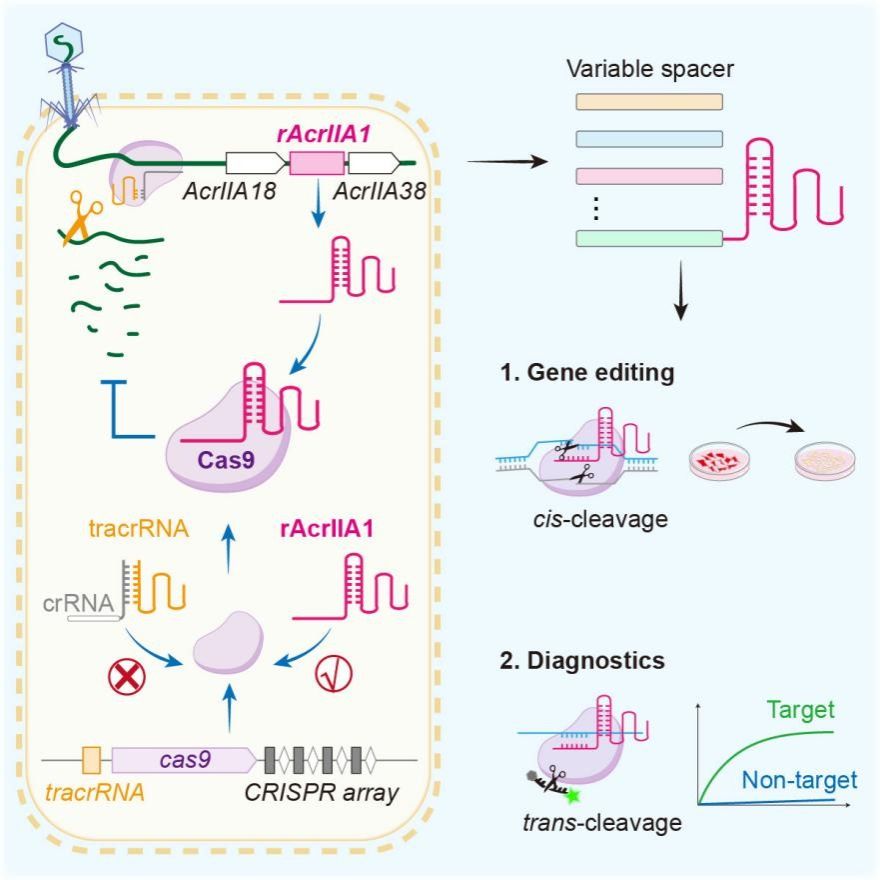
In summary, in the face of the CRISPR-Cas immune system, phages have evolved an extremely efficient solution: a compact RNA of only about 111 nt that structurally mimics the entire sgRNA—it can both competitively block the loading of natural crRNA and itself guide Cas9 to DNA. With a minimal molecular size, rAcrIIA1 accomplishes two seemingly opposing missions, “inhibition” and “guidance”: as a natural anti-CRISPR RNA, it serves as a potent weapon for immune evasion in the arms race between phages and their hosts; as a fully programmable and highly efficient guide RNA, it can be widely applied in prokaryotic and eukaryotic systems for genome editing, gene silencing, molecular diagnostics, and other fields. Overall, rAcrIIA1 not only opens a new chapter in the phage–host arms race but also broadens the application landscape of the CRISPR-Cas9 toolkit—from gene editing to nucleic acid detection, it holds promise across the board. A molecule born to counteract CRISPR has ultimately become a new member of the CRISPR toolbox; this is perhaps the most intriguing gift that the microscopic arms race has left to humanity.
