The nucleolus is the largest membrane-less biomolecular condensate in the cell. It comprises three substructures—the fibrillar centre (FC), dense fibrillar component (DFC) and granular component (GC)—and is the central site of ribosome biogenesis. When cells are exposed to stresses such as DNA damage or transcriptional inhibition, the nucleolar structure undergoes reorganization and forms a dark nucleolar cap (DNC). Previous studies have shown that the nucleolus can establish a pH gradient through the electrochemical properties of its constituent proteins, without relying on ATP-driven proton pumps, thereby maintaining the structural and functional homeostasis of the condensate. The canonical nuclear speckle splicing factor SRSF1 was previously thought to participate exclusively in mRNA splicing. Whether it contributes to the nucleolar stress response or regulates the pH microenvironment of condensates had not been reported.
On 28 September 2026, the team led by Wang Bo at the School of Life Sciences published a research Article online in Nature Chemical Biology entitled “SRSF1 modulates the dark nucleolar cap pH to restore nucleolar integrity and function”, providing initial insight into a previously unrecognized mechanism by which SRSF1 regulates nucleolar stress homeostasis. The study showed that, under conditions in which rRNA synthesis is impaired, SRSF1 specifically relocates from nuclear speckles to the DNC rather than becoming enriched in conventional nucleolar subregions, and that this phenomenon is broadly observed across multiple tumour cell types. The N-terminal RRM1 domain of SRSF1 is the key element responsible for its localization to the DNC. Under stress conditions, SRSF1 also forms a complex with the nucleolar helicase DDX18, which is an important prerequisite for its transport to the DNC. Further analyses revealed that the DNC has a distinctive alkaline pH microenvironment, clearly differing in physicochemical properties from nuclear speckles and other nucleolar subregions. SRSF1 and its family members can maintain the alkaline microenvironment of the DNC. The high net positive charge of the arginine/serine-rich (RS) disordered domain at the C terminus is critical for DNC alkalinization, and this function is independent of its canonical role in RNA splicing. Loss of SRSF1 led to defective nucleolar remodelling after stress, impaired rRNA processing and accumulation of DNA damage. These defects could be rescued only by SRSF1 containing an intact, highly positively charged RS domain. On the basis of this property, the team synthesized a highly positively charged RA tandem peptide that specifically targets the nucleolus, effectively repairs nucleolar stress damage and restores rRNA-processing function.
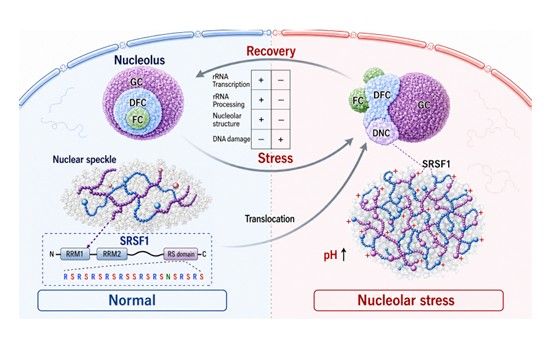
In summary, this study is the first to show that the canonical splicing factor SRSF1 regulates the formation of a pH gradient in a biomolecular condensate through the charge characteristics encoded in its primary protein sequence. The work expands the current model of pH regulation in biomolecular condensates and further supports the view that pH gradients in biomolecular condensates are determined by the intrinsic sequences of charged amino acids in their constituent proteins. It also reveals a previously unrecognized non-splicing function of the RS domain.
The Wang Bo team has long focused on phase separation in biomolecular condensates and the mechanisms governing charge-dependent regulation. In an earlier study published in Molecular Cell, the team elucidated the molecular mechanism by which a phosphorylation-dependent charge block in SRRM2 regulates nuclear speckle fusion. The present work extends this research to pH and charge regulation in the DNC under stress and establishes a systematic framework linking protein charge, the physicochemical properties of condensates and cellular stress homeostasis.
Suibin Ma, a PhD student at Xiamen University (now graduated), and Jierui Guo, a master’s student (now graduated), are co-first authors. Xiang Zhan, a master’s student, Fan Wu, a PhD student, and Shuo Yang, a master’s student (now graduated), made important contributions to this work. Professor Bo Wang is the corresponding author. Chaoqun Huang of the Fifth Hospital of Xiamen provided essential experimental and technical support. This work was supported by the National Natural Science Foundation of China, the Natural Science Foundation of Fujian Province and other funding sources.
Original article: https://www.nature.com/articles/s41589-026-02316-9
