Much research has been devoted to the health problems that may result from nutrient deficiency. However, with rising standards of living, the daily nutrient intake of most people today has exceeded bodily requirements. Research on the health effects of nutrient excess has mainly focused on three major nutrients: carbohydrates, fats, and proteins. In contrast, very little is known about how an excess of low-abundance yet essential nutrients, such as magnesium, affects the body, as well as its underlying molecular mechanisms. Although dietary magnesium deficiency and hypomagnesemia are closely associated with various diseases, including infections and cancer, the physiological regulatory effects of elevated magnesium levels are by no means a "simple reversal" of the low-magnesium state, suggesting that they may be mediated by novel regulatory mechanisms beyond the role of magnesium ions as enzyme cofactors.

Recently, Prof. Geng Wang’s team at Xiamen University published a research paper titled "Inhibition of a magnesium-sensitive double-stranded RNA clearance machinery boosts cancer immunotherapy" in Cell Research, revealing that ribonuclease RNASET2 is a key target in cellular responses to high concentrations of magnesium ions (Mg²⁺). High concentrations of Mg²⁺ specifically inhibit RNASET2 activity, causing the accumulation of mitochondrial double-stranded RNA (mt-dsRNA), which in turn activates cytosolic RNA-mediated innate immunity and significantly boosts anti-tumor immune responses. Through AI-assisted structural and functional predictions, the researchers screened and identified a mutant that retains partial RNASET2 activity, but whose activity is not inhibited by magnesium. In cells and tumors overexpressing this mutant, magnesium-induced immune activation and anti-tumor effects were largely abolished.
The study also found that mt-dsRNA may be one of the primary immunogens driving cytosolic innate immune responses in many cancer cells. Previous studies focusing on the cGAS-STING pathway rarely considered or excluded changes in RNA-sensing immune signaling simultaneously. Therefore, in cancer research, cytosolic dsRNA-mediated innate immune responses should receive at least equal attention as DNA-mediated innate immune responses. It should be noted that the anti-tumor effects of high magnesium may also be accompanied by certain side effects. Long-term overactivation of nucleic acid-mediated innate immunity is linked to various autoimmune diseases. Thus, while the inhibition of mt-dsRNA clearance by magnesium may enhance anti-tumor immunity, it might also participate in the pathogenesis and progression of related autoimmune conditions.
First, by analyzing The Cancer Genome Atlas (TCGA) database, the research team found that the ribonuclease RNASET2 is highly expressed in most cancer types, including skin cutaneous melanoma (SKCM) and colorectal cancer (CRC). Kaplan-Meier survival analysis further demonstrated that higher RNASET2 expression levels correlate with worse overall survival in cancer patients. Compared with tumors expressing high levels of RNASET2, tumors with low RNASET2 expression displayed increased immune cell infiltration. These clinical and pathological data together indicate that tumor cells may upregulate RNASET2 expression to suppress immune cell infiltration, thereby achieving immune evasion.
Further mechanistic studies revealed that RNASET2 is a critical clearance machinery limiting mt-dsRNA accumulation. Combining transcriptomic analysis, subcellular localization, electron microscopy observation, and J2 antibody-enriched dsRNA pull-down assays across multiple experimental levels, the team found that RNASET2 deficiency leads to the abnormal accumulation and cytosolic release of mt-dsRNA. This cytosolic mt-dsRNA is then sensed by cytosolic RNA pattern recognition receptors, resulting in sustained activation of downstream type I interferon (IFN-I) responses. In mouse models of melanoma and colorectal cancer, knocking down RNASET2 significantly promoted the infiltration of various immune cells within tumor tissues. In athymic nude mouse models lacking mature T cells, RNASET2 knockdown still effectively inhibited tumor growth, confirming that the innate immune response induced by RNASET2 deficiency alone possesses potent anti-tumor efficacy. To further verify whether the anti-tumor effect depends on mt-dsRNA-mediated innate immune responses, the researchers constructed B16F10 cells with double knockdowns of RNASET2/MAVS and RNASET2/IFNAR1 to block dsRNA signal transduction and type I interferon responses, respectively. The results showed that knocking down MAVS or IFNAR1 counteracted the anti-tumor effects brought by RNASET2 deficiency. This demonstrates that the anti-tumor effects induced by RNASET2 knockdown depend on the activation of the "dsRNA sensing–MAVS–IFN-I" signaling axis.
Subsequently, utilizing AlphaFold structural prediction and in vitro reconstituted enzymatic activity assays, the research team discovered that Mg²⁺ can specifically bind to the catalytic active site of RNASET2, thereby inhibiting its RNA degradation activity towards mitochondrial RNA. Cellular experiments showed that exogenous Mg²⁺ supplementation induced phenotypes similar to RNASET2 knockdown. Through structural and functional predictions, the researchers identified an RNASET2 mutant that retains partial activity insensitive to magnesium inhibition. In cells overexpressing this mutant, the immune-activating effects of magnesium largely disappeared, indicating that Mg²⁺ promotes mt-dsRNA accumulation and activates innate immune responses primarily by specifically inhibiting the nuclease activity of RNASET2.
Finally, the researchers further explored whether a high-magnesium diet could activate innate immune responses in vivo and exert anti-tumor effects. The results indicated that while a high-magnesium diet did not affect the activation state of mouse T cells, it significantly suppressed tumor growth rates and increased immune infiltration levels within tumor tissues. In tumors overexpressing the magnesium-insensitive RNASET2 mutant, the anti-tumor effects of magnesium largely disappeared. Dietary supplementation with Mg²⁺ can likewise inhibit RNASET2 activity in vivo, thereby activating mt-dsRNA-mediated immune responses and producing distinct anti-tumor effects. This strategy offers better feasibility and potential clinical application value.
In summary, this study systematically elucidates the "Mg²⁺–RNASET2–mt-dsRNA–innate immunity" regulatory axis, reveals the molecular mechanism by which RNASET2 regulates mt-dsRNA homeostasis, and demonstrates that elevated levels of Mg²⁺ promote abnormal accumulation of mt-dsRNA by specifically inhibiting RNASET2 activity, thereby activating cytosolic RNA sensing pathways. Furthermore, in vivo experiments confirmed that a high-magnesium diet can effectively enhance anti-tumor immunity and curb tumor progression. This study establishes a mechanistic link between mitochondrial RNA homeostasis and the tumor immune microenvironment for the first time, demonstrating that modulating endogenous dsRNA clearance mechanisms can serve as an effective pathway to activate anti-tumor immunity, while also providing new targets and strategies for cancer immunotherapy targeting mt-dsRNA.
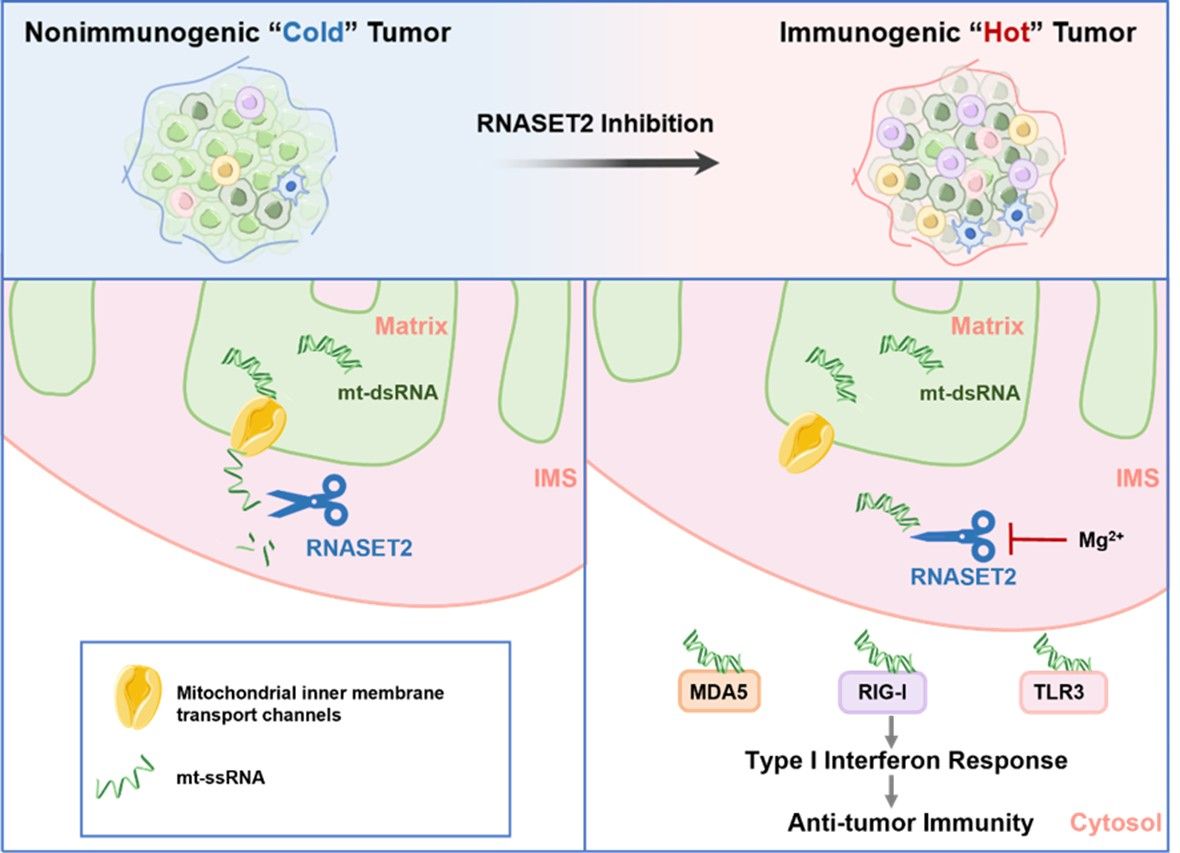
Schematic Diagram: Magnesium ions activate anti-tumor immunity by inhibiting RNASET2-mediated degradation of mt-dsRNA.
Authors & Funding: Ph.D. student Zhirong Zhang and Postdoctoral fellow Dr. Lixiao Zhang from the School of Life Sciences, Xiamen University, are co-first authors of the paper. Prof. Geng Wang, Associate Researcher Pengcheng Wang, and Assistant Prof. Sipeng Wu are co-corresponding authors. This study was supported by the National Natural Science Foundation of China (32450418, 91949103, 32071159), National Key R&D Program of China (2025ZD0549800), Ministry of Science and Technology Key R&D Program (2017YFA0504600), and the China Postdoctoral Science Foundation (2026M792891).
Original Article Link: https://www.nature.com/articles/s41422-026-01301-0
