Diatoms are among the most important primary producers in marine ecosystems. Their siliceous cell wall (frustule) serves not only as the first barrier against mechanical damage, grazing, viral entry, and ultraviolet radiation but also as a key intersection of materials science, cell biology, ecology, and climate change research. However, how diatoms adapt to environmental stress by adjusting the silicification or components of their cell walls has long remained an open question. Addressing this question is important not only for understanding the ecological success of diatoms in marine ecosystems but also for providing new ideas for biological silica nanotechnology, marine carbon sequestration, and species interactions.
On October 7, 2026, Prof. Junrong Liang’s team at the School of Life Sciences, Xiamen University, together with Prof. Thomas Mock at the University of East Anglia, UK, published an online paper entitled “The Ratio of Silicon to Chitin in Diatom Cell Walls Influences Their Resilience to Environmental Stress” in Research. Using the model diatom Thalassiosira pseudonana, the study found that resting cells remodel their frustule by increasing the silicon-to-chitin ratio in the cell wall, thereby enhancing resistance to chemical pollutants and chitin-degrading bacteria. The study further identified the key girdle-band structural protein cingulin W2 (CinW2) and the upstream transcription factor AP2-1, revealing for the first time the molecular regulatory mechanism underlying the plasticity of diatom cell wall chemical composition. This work is another important advance by the team following its 2024 New Phytologist and 2026 Plant Journal studies on the survival strategies of diatom resting cells.
1. Resting-cell frustules undergo “high-silicon, low-chitin” chemical remodeling
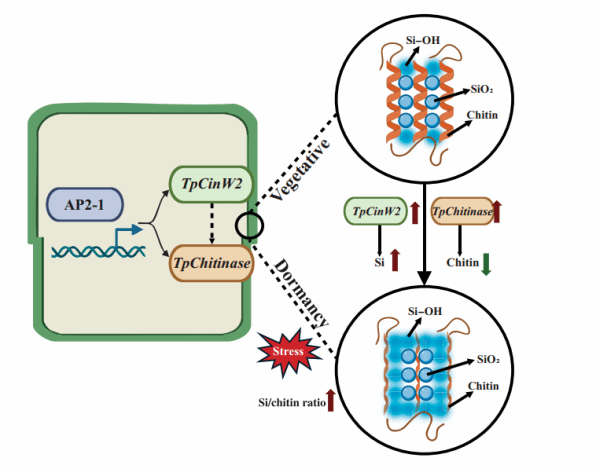
Dormancy is an important survival strategy for diatoms to endure unfavorable conditions such as cold, darkness, and nutrient limitation. Unlike spores or dinoflagellate cysts, which enhance resistance through marked structural remodeling, diatom resting cells are morphologically similar to vegetative cells, and how their cell walls exert protection remains unclear. This study found that T. pseudonana resting cells were markedly reduced in volume; the silicon content per unit cell wall surface area, silanol (Si–OH) groups, and surface potential increased, whereas pore volume, carbon content, and chitin content decreased. EDS analysis showed that silicon was enriched in the girdle-band region. These results indicate that resting cells form a denser and stronger cell wall by increasing the silicon-to-chitin ratio, revealing a “morphologically similar but chemically remodeled” protection strategy and providing a new perspective for understanding the protective mechanisms of diatom resting cells.
2. Transcriptomics and reverse genetics identify the key protein CinW2
To dissect the mechanism of cell wall remodeling, the team reanalyzed the transcriptome of resting cells and found that the gene encoding the girdle-band protein CinW2, TpCinW2, was among the most globally upregulated genes. Meanwhile, the chitinase TpChitinase was upregulated, while chitin synthase B TpChitin synthase B was downregulated, consistent with reduced chitin. Through overexpression (OE-CinW2) and CRISPR-Cas9 knockout (KO-CinW2), the team confirmed that overexpression increased silicon content in the frustule, decreased chitin, and increased the silicon-to-chitin ratio, whereas knockout had the opposite effect. Cell size did not change significantly, indicating that the phenotype arose from changes in cell wall chemical composition rather than size effects. This result directly links cingulin family proteins to the regulation of silicon content in diatom cell walls for the first time.
3. The AP2-1 transcription factor coordinates silicon/chitin metabolism
Through promoter analysis and transcriptome screening, the team identified the AP2/ERF family transcription factor TpAP2-1. Yeast one-hybrid and dual-luciferase assays showed that AP2-1 directly binds to and activates the TpCinW2 and TpChitinase promoters, but does not bind to the TpChitin synthase B promoter. Therefore, AP2-1 coordinates “high-silicon, low-chitin” cell wall remodeling by simultaneously activating CinW2 and chitinase. This is the first transcription factor identified in diatoms that regulates cell wall chemical composition, and the first demonstration that a single transcription factor can coordinate two functionally distinct genes involved in silicon deposition and chitin degradation.
4. Enhanced multiple stress resistance and ecological conservation
Under stress from benzo[a]pyrene (BaP) and widely present chitin-degrading bacteria, resting cells and OE-CinW2 showed higher survival rates, whereas KO-CinW2 showed increased mortality and broken or deformed girdle bands. Purified chitinase treatment confirmed that the high-silicon, low-chitin cell wall can effectively resist enzymatic attack. These results indicate that an increased silicon-to-chitin ratio is a key adaptive strategy for diatoms to cope with chemical and biological stress, and that cell wall chemical composition itself, rather than only the dormant physiological state, determines stress resistance. Tara Oceans data showed that AP2-1 and chitin metabolism-related genes are widely distributed among diverse diatoms, and their expression correlates with silicate concentration. In two other Thalassiosira species, silicon-replete conditions produced a “high-silicon, low-chitin” phenotype with stronger stress resistance, whereas silicon limitation had the opposite effect. These findings suggest that enhancing cell wall defense by adjusting the silicon-to-chitin ratio may be a general strategy for diatoms to cope with environmental change. The study also proposed an ecological feedback model: when silicon is sufficient, the cell wall is highly silicified and defense is strong; when silicon is limited, chitin compensates but is more susceptible to chitinase attack, accelerating bloom decline and releasing silicic acid, thereby promoting the formation of a high-silicon resting-cell “seed bank.”
Conclusion
In summary, this study establishes for the first time the “AP2-1–CinW2/chitinase–silicon-to-chitin ratio–environmental resistance” regulatory axis, linking the plasticity of diatom cell wall components to marine ecological adaptation. It provides new insights for understanding diatom adaptation and evolution in a changing ocean, as well as for the design and functional modification of silica-based nanomaterials.
Authors and Funding
PhD student Mengyuan Hao and master’s students Runyu You, Zhouyi Jiang, and Linwei Liu from the School of Life Sciences, Xiamen University, are co-first authors. Professor Junrong Liang from the School of Life Sciences, Xiamen University, and Professor Thomas Mock from the University of East Anglia are co-corresponding authors. Lu Huang, a former PhD student from the School of Life Sciences, Xiamen University, and Professor Naikun Shen from Guangxi Minzu University also made important contributions to the study. The study also received support and assistance from Professor Yun Tian’s team at the School of Life Sciences, Xiamen University. This research was supported by the National Natural Science Foundation of China (42076115 and 41576138).
Original article link: https://doi.org/10.34133/research.1452
