Recently, the research team led by Professor Jifeng Yuan from the School of Life Sciences, Xiamen University, has achieved groundbreaking progress in the microbial synthesis of vitamin E. The team identified and reconstructed a nonclassical biosynthetic pathway for α-tocopherol originating from photosynthetic bacteria of the genus Rhodobacter. Through systematically metabolic engineering, efficient heterologous biosynthesis of vitamin E was realized, with the titer setting a new record among all published literatures. The relevant study was published in the top international journal Nature Metabolism under the title “A nonclassical biosynthetic route enables tocopherol synthesis in bacteria”.
Research Background and Content
Vitamin E, containing tocopherols and tocotrienols, is a crucial class of lipid-soluble antioxidants widely applied in pharmaceuticals, nutritional health products, animal feed and food processing industries. Among different forms of vitamin E, α-tocopherol dominates market demand owing to its highest biological activity. At present, approximately 80% of global α-tocopherol supply comes from chemical synthesis, whereas extraction from natural plant oils is limited by long plant growth cycles and complicated separation and purification workflows. Constructing green and sustainable biosynthetic routes via microbial cell factories represents a highly promising alternative strategy. Nevertheless, this field has long been plagued by the bottleneck of low tocopherol yields. The typical plant-derived α-tocopherol biosynthetic pathway heavily relies on DMPBQ, a key intermediate whose complete reconstruction in heterologous microbes poses tremendous challenges.
In this study, when a minimal δ-tocopherol synthetic module harboring only three enzymes (HPPD, HPT, and TC) was introduced into the photosynthetic bacterium Rhodobacter sphaeroides, α-tocopherol was unexpectedly detected. This observation confirms that this strain harbors a more streamlined, nonclassical biosynthetic pathway. Combined with bioinformatic analysis and biochemical validation, the research team successfully deciphered the underlying molecular mechanisms, as detailed below.
1. Bifunctional Methyltransferase Activity of UbiE
The endogenous methyltransferase UbiE, which participates in ubiquinone biosynthesis in R. sphaeroides, was discovered to possess an unreported bifunctional activity as γ/β-tocopherol methyltransferase (γ/β-TMT). This enzyme bypasses the DMPBQ-dependent step required by typical pathways, directly converting δ-tocopherol into γ/β-tocopherol and subsequently α-tocopherol (Figure 1). Molecular dynamics simulations and site-directed mutagenesis further uncovered its distinctive substrate recognition pattern and regioselective catalytic mechanism.
2. Tocotrienol Reduction Mediated by BchP
No tocotrienols were detected alongside tocopherol production in R. sphaeroides, implying that the endogenous geranylgeranyl reductase, BchP, is capable of reducing tocotrienols. Heterologous catalytic characterization in Escherichia coli verified that BchP efficiently reduces δ-tocotrienol to corresponding tocopherols with the assistance of ferredoxin (FdxA) and NADPH-ferredoxin reductase (Fdr). The elucidation of this function removes a critical obstacle to reconstructing tocopherol synthetic pathways in heterologous hosts including E. coli and yeast.
Drawing on the above mechanistic discoveries, the team engineered a high-performance cell factory using R. sphaeroides as the chassis strain. Transposon mutagenesis was utilized to integrate and overexpress key genes for reinforcing the supply of precursors, GGPP and homogentisate. Coupled with systematically metabolic engineering and fermentation optimization (supplementation with L-methionine and 2-hydroxypropyl-β-cyclodextrin), the engineered strain produced a total vitamin E titer of 3.51 g/L in a 5 L fermenter under the fed-batch fermentation, with α-tocopherol accounting for 35% and γ/β-tocopherol accounting for 65%. This titer stands as the highest value of microbially synthesized vitamin E reported in all publicly available literatures to date.
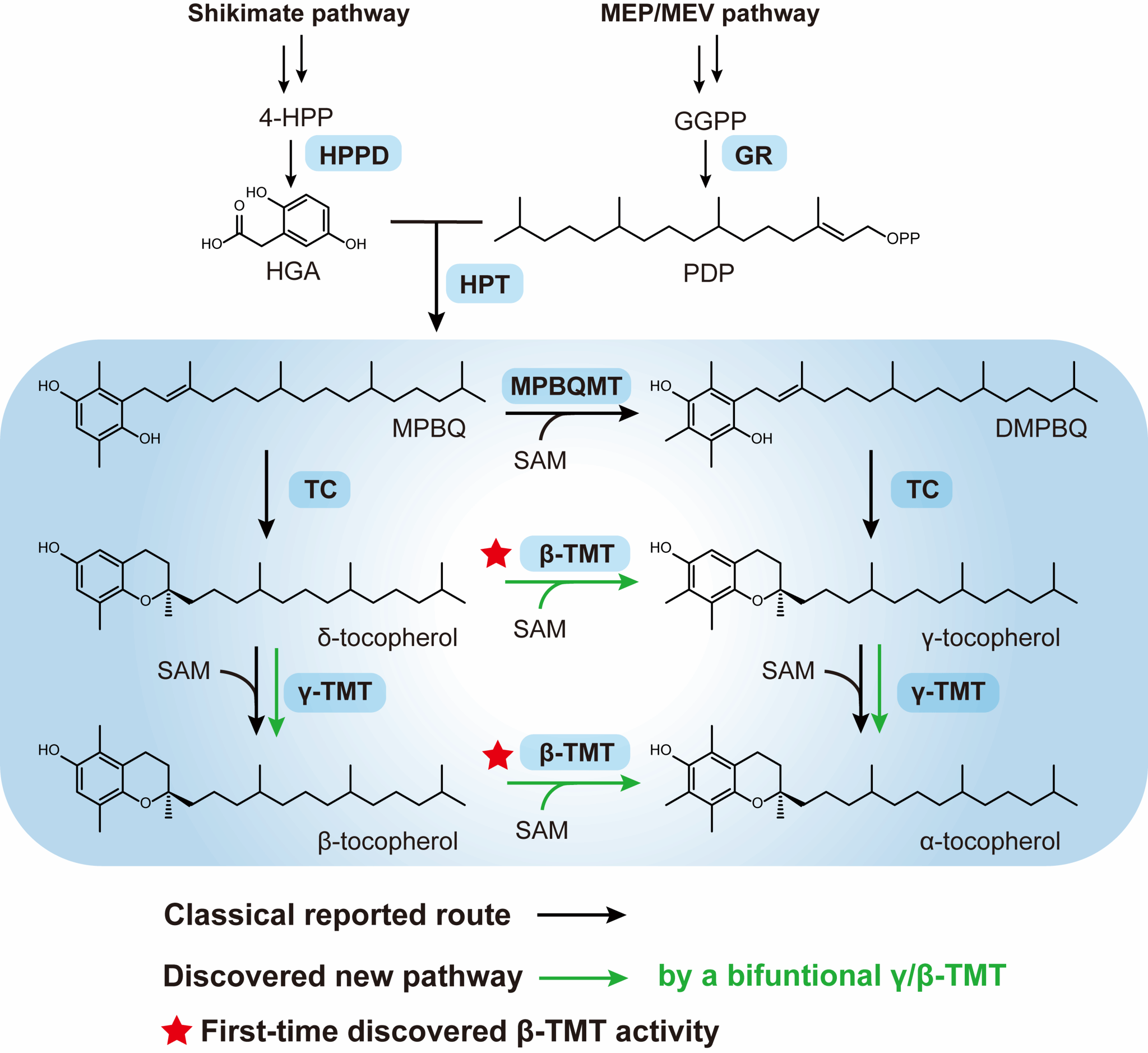
Schematic diagram of classical tocopherol biosynthetic pathway from oxygenic photosynthetic organisms and newly-identified pathway in anoxygenic photosynthetic bacteria.
Research Significance
This work delivers multiple landmark breakthroughs for the green biomanufacturing of vitamin E:
1. For the first time, efficient heterologous biosynthesis of tocopherols in microbes was achieved with a high titer of 3.51 g/L, breaking the long-standing technical bottleneck restricting this research field.
2. A novel bifunctional methyltransferase UbiE with both β-TMT and γ-TMT activities was identified and characterized, marking the first report of an enzyme possessing both catalytic activities. Its unique substrate promiscuity and regioselectivity revise the classical understanding of tocopherol methylation steps. The study validates a simplified nonclassical α-tocopherol synthetic pathway, expands fundamental knowledge on biosynthetic approach of natural products, and provides efficient novel bioparts and innovative pathway design strategies for synthetic biology research.
3. The tocotrienol reduction activity of BchP was functionally verified, resolving the core challenge of functional geranylgeranyl reductase expression in heterologous hosts and paving the way for tocopherol production in diverse industrial model microorganisms.
This research establishes solid theoretical foundations and technical support for the commercial bioproduction of natural vitamin E via microbial fermentation.
Author Information and Funding Acknowledgements
The co-first authors of this paper are Associate Professor Yang Zhang, PhD student Zhizhen Li, and Associate Professor Lichuang Cao (Sun Yat-sen University), while Professor Jifeng Yuan serves as the corresponding author. This work was supported by the National Key Research and Development Program of China, the National Natural Science Foundation of China, the Natural Science Foundation of Xiamen, China, the Fundamental Research Funds for the Central Universities.
Paper link: https://doi.org/10.1038/s42255-026-01576-y
