Plague, a highly virulent infectious disease that once rewrote the course of human history, continues to pose a persistent threat to public health in numerous natural foci around the world. In China, it is classified as the top-tier Class A infectious disease and is commonly referred to as "Disease No. 1." The key to precise prevention and control of plague lies in genotyping its pathogen—Yersinia pestis (Y. pestis) —which is essential for rapidly tracing its origins. However, current genotyping technologies have long relied on bacterial culture and whole-genome sequencing, which place extremely high demands on experimental conditions and specialized personnel, making it difficult to implement these methods at remote field stations with limited resources. Furthermore, given Y. pestis’s high infectivity, high mortality rate, and potential threat as a bioterrorism agent, the World Health Organization has designated it as a priority pathogen requiring stringent control, making the lag in the field deployment of genotyping technologies even more pronounced.
In 2021, the national key R&D program “Standardization and Evaluation of Plague Diagnostic Reagents and Research on Traceability Technologies” was approved. In 2022, a major special project titled “Research on Key Technologies for Plague Prevention and Control” was simultaneously launched in Inner Mongolia Autonomous Region. The genotyping technology research for both projects is being undertaken by Engineering Research Centre of Molecular Diagnostics, Ministry of Education. Under the leadership of Professor Li Qingge, the center, in collaboration with the Academy of Military Medical Sciences, the Inner Mongolia Autonomous Region Center for Disease Control and Prevention, and the Chinese Center for Disease Control and Prevention has successfully developed a Y. pestis typing technology that can be deployed in field settings. The related findings, titled “A field-deployable high-resolution SNP genotyping platform for rapid surveillance of Yersinia pestis,” were published in the international journal Virulence. This study combines the team’s independently developed ARMS-HANDS PCR technology with multicolor melting curve analysis to create a high-resolution SNP genotyping platform that can be deployed in the field. The platform achieves full-process automation—from sample preparation to result output—providing a brand-new technological approach for rapid genotyping and precise monitoring of plague outbreaks in the field.
Technical Solution: The Three-Tube Reaction Locks onto 24 Global Lineages and 9 Prominent Sublineages in Inner Mongolia.
The research team, based on a large-scale genomic analysis of over 3,000 Y. pestis strains, identified 37 canonical SNP loci (canSNPs): 25 for distinguishing the 24 major global lineages and 12 for resolving the nine dominant sublineages prevalent in Inner Mongolia. These sites have undergone rigorous validation and exhibit characteristics such as high evolutionary stability, low information redundancy, and ease of primer design.
Building on this foundation, the team integrated ARMS-HANDS PCR with multicolor melting curve analysis to develop a closed-tube multiplex SNP genotyping system. This approach uses "universal Tag primers" to initiate asymmetric amplification, effectively suppressing primer-dimer formation in multiplex reactions by allowing them to form pan‑handle structures. After the self-quenching probes anneal to the amplicons, characteristic melting peaks are generated across different fluorescence channels, allowing SNP genotypes to be determined based on melting temperature differences. The entire assay is completed within two hours in a sealed tube, eliminating the need for any post-PCR tube-opening steps and laying the groundwork for field deployment. Methodological performance evaluation shows that this platform boasts excellent technical parameters: its detection limit is as low as 50 genomic copies per reaction, representing a reduction of several orders of magnitude compared to the nanogram-level DNA input required by conventional genotyping methods. The melting temperature (Tm) exhibits good repeatability (standard deviation: 0.051–0.407℃), and adjacent melting peaks show no cross-interference. Furthermore, the platform demonstrates reliable specificity with no cross-reactivity against closely related species such as Yersinia pseudotuberculosis and Yersinia enterocolitica.
Real-world validation: "Sample in—Result out" on the grassland.
To validate the accuracy of the monitoring system, the research team employed a double-blind design and tested 166 DNA samples from Y. pestis strains that had been pre-genotyped by whole-genome sequencing. The results showed that the genotyping accuracy reached 100%, fully consistent with the whole-genome sequencing results, covering 17 global lineages as well as all dominant sublineages in the Inner Mongolia region.
Furthermore, the research team integrated this platform into a portable “sample-in—result-out” device called Sanit y2.0, which was directly applied to liver samples of infected Mongolian gerbils collected at the plague field monitoring station in Otog Banner, Inner Mongolia (Figure 1A). From sample processing to obtaining the final typing results, the entire process takes only about 120 minutes (Figure 1B). All nine field samples were accurately identified as belonging to the 2.MED3.1.4 sublineage under the 2.MED3 lineage—this finding is highly consistent with epidemiological data indicating that, between 1948 and 2021, the 2.MED3.1.2 and 2.MED3.1.4 sublineages were the dominant circulating strains in this region (Figure 1C). At the same time, these results fully concurred with the validation results obtained using the real-time PCR instrument, thereby thoroughly demonstrating the platform’s reliability and practicality under field conditions.
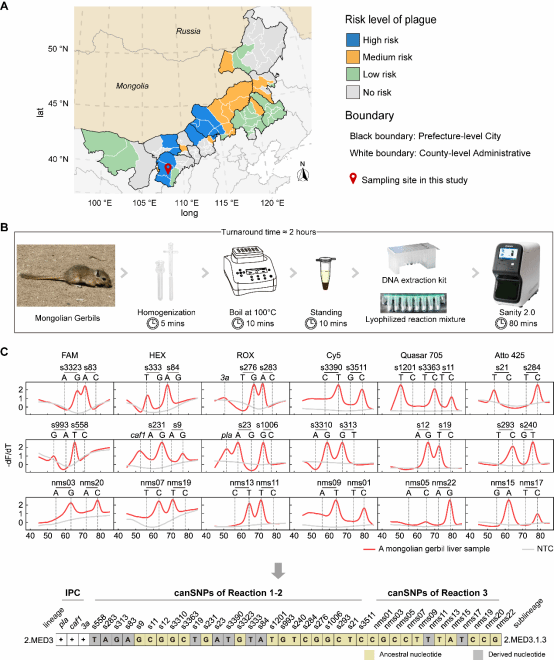
Figure 1. Subtyping of Y. pestis from Mongolian gerbil livers and its geographical context. (A) Geographical distribution of 59 Plague Field Monitoring Stations across high-, medium-, and low-risk administrative divisions in Inner Mongolia Autonomous Region, China, alongside sampling site for nine Mongolian gerbil liver specimens analysed in this study. Risk levels are color-coded by administrative division, with adjacent provinces and international borders annotated for spatial reference. Geospatial data were sourced from the National Geomatics Center of China (https://www.tianditu.gov.cn/). (B) Workflow for subtyping Y. pestis directly from gerbil liver specimens. (C) Representative MMCA assay results for sample No.5. NTC: no template control; MMCA: multicolour melting curve analysis.
This study closely integrates basic research with public health practice, validating the potential of ARMS-HANDS PCR and multicolor melting curve analysis techniques in both clinical and field settings. It represents a vivid example of how our research team is addressing major national needs by conducting research on field-testing technologies. With further optimization, the platform holds promise for deployment in remote and frontier settings, where it could serve as a robust tool for safeguarding public health and biosafety.
The co-first authors of the paper are Liu Ying, a postdoctoral fellow at the School of Chemistry and Chemical Engineering at Xiamen University; Huang Qiuying, an associate professor at the School of Life Sciences at Xiamen University; and Wu Yarong, a postdoctoral fellow at the Academy of Military Medical Sciences (who has now joined Tianjin University). The co-corresponding authors are Professor Li Qingge from the School of Life Sciences at Xiamen University and Researcher Cui Yujun from the Academy of Military Medical Sciences. This research was supported by the National Key Research and Development Program, the Major Science and Technology Special Project of the Inner Mongolia Autonomous Region, and the Major Science and Technology Project of Xiamen City.
Article link: https://pubmed.ncbi.nlm.nih.gov/42418343/.
