Acute myeloid leukemia (AML) is a highly aggressive hematologic malignancy. NPM1 mutation is the most common driver variant in adult AML, accounting for approximately 30-35% of cases, with 80% being type A (TCTG tetranucleotide insertion). This mutation leads to cytoplasmic mislocalization of the protein (named NPM1c) by acquiring a nuclear export signal and losing nucleolar localization. Recent studies have shown that NPM1c can enter the nucleus to exert transcriptional activation, upregulating oncogenic factors such as HOXA and MEIS1, thereby driving AML development. However, NPM1c lacks a druggable pocket, and directly targeting mutant NPM1c remains an urgent unmet clinical need.
Recently, the research team led by Profs. Lanfen Chen and Dawang Zhou from the State Key Laboratory of Cellular Stress Biology, School of Life Sciences / Xiang'an Hospital of Xiamen University published a study in Leukemia titled "Small interfering RNA-mediated silencing of mutant NPM1 suppresses acute myeloid leukemia via reversing KAT7 and p300-mediated histone acetylation". The study developed an allele-specific siRNA that selectively silences mutant NPM1c while preserving wild-type NPM1 function, and systematically evaluated its anti-leukemia efficacy in cells and mouse models. Furthermore, it elucidated the mechanism by which NPM1c drives AML development by recruiting the acetyltransferases KAT7 and p300 to establish a pathogenic acetylome and open chromatin state.
To achieve specific targeting, the researchers first designed a library of 16 siRNAs spanning the TCTG insertion site, each offset by a single nucleotide, and screened out a lead sequence (designated siNPM1c) that specifically knocks down mutant NPM1c without affecting wild-type NPM1 expression. Subsequently, by designing a library of 27 chemically modified siRNA candidates, they obtained an optimized molecule (siNPM1c‑AM) with high silencing activity that was sustained over an extended duration (up to 9 days). In vitro experiments confirmed that siNPM1c‑AM significantly inhibits AML cell proliferation and colony formation, and induces apoptosis and differentiation.
Further mechanistic studies revealed that knocking down NPM1c significantly weakens the occupancy of acetyltransferases KAT7 and p300 at the regulatory regions of classic target genes such as HOXA and MEIS1, downregulating H3K14ac and H3K27ac levels. This reduces chromatin accessibility and suppresses target gene expression. In animal models, the research team utilized LNP encapsulation technology combined with a strategy of pre‑injecting empty LNPs to saturate liver uptake, successfully enriching the siRNA in hematopoietic niches such as the spine and long bones. This therapy delayed leukemia progression and prolonged survival in both NPM1c‑mutated cell line‑derived xenograft (CDX) and patient‑derived xenograft (PDX) models, while showing no response in non‑NPM1 mutated models. Importantly, siNPM1c‑AM exhibited a strong synergistic effect when combined with the clinical menin inhibitor revumenib; even in CDX models carrying the revumenib resistance mutation (MEN1‑M327I), siNPM1c‑AM monotherapy could still inhibit proliferation and extend survival, demonstrating its great potential to overcome clinical drug resistance.
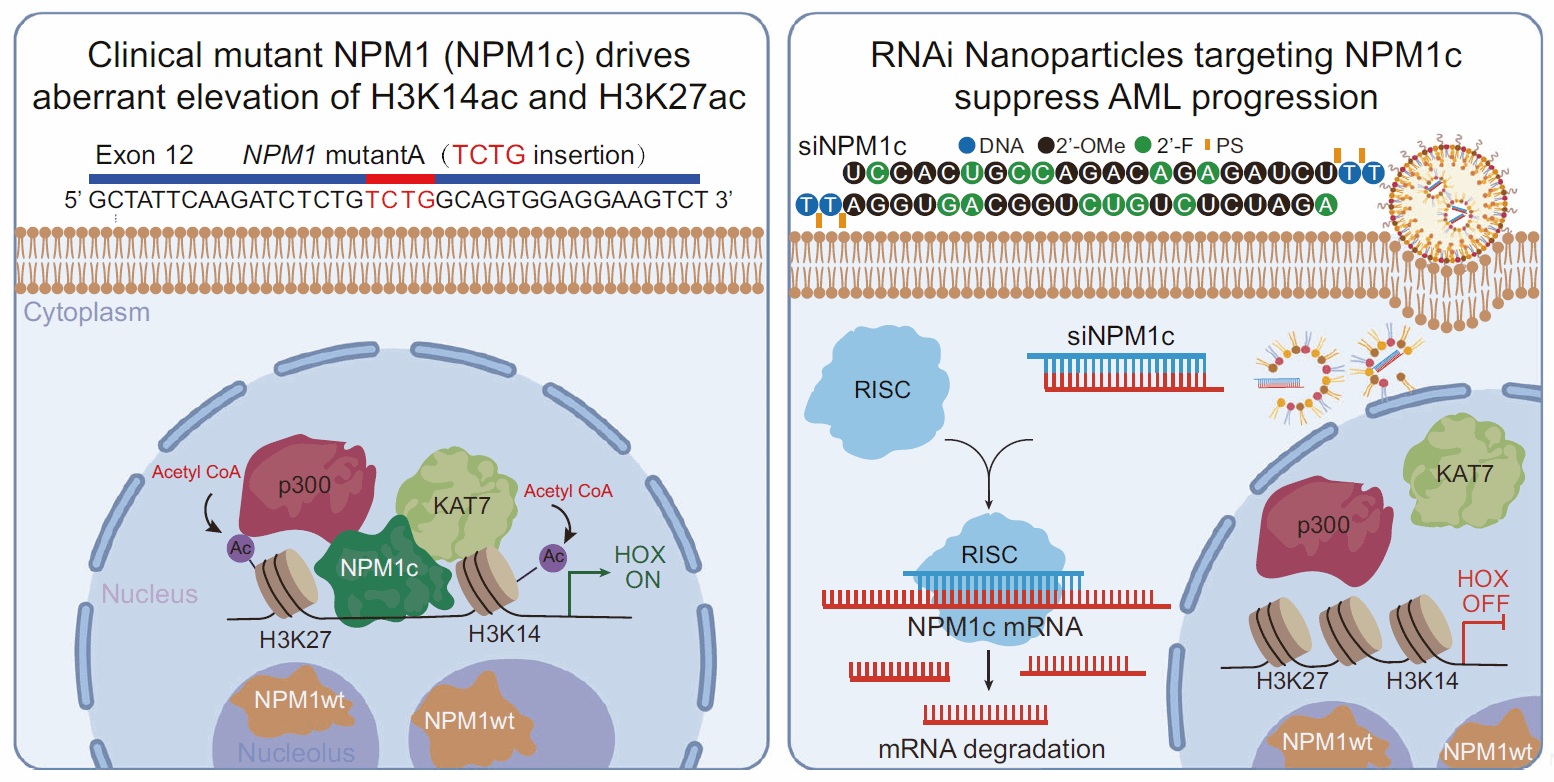
In summary, this study successfully developed a n siRNA sequence specifically targeting NPM1c mutation for in vivo therapy, confirmed its efficacy, and elucidated the novel mechanism of NPM1c recruiting KAT7 and p300 to drive AML. It provides a promising new strategy for NPM1-mutated AML treatment, and core technologies have been applied for domestic and international patents. Despite positive progress in mouse models, the therapy still faces several key challenges, including optimization of siRNA chemical modifications, systematic evaluation of immunogenicity, and improvement of LNP targeted delivery efficiency. The team looks forward to conducting practical cooperation with relevant biopharmaceutical companies to jointly explore the future clinical application prospects of this therapy.
Prof. Lanfen Chen and Prof. Dawang Zhou of Xiamen University are the co-corresponding authors of the study. The study's co-first authors are Yongqiang Hou (Assistant Professor), Yunzhi Xing (PhD student), Chunjie Chen (PhD student), and Dongxue Su (Associate Professor) from Xiamen University. Prof. Jun Long from Tongji Hospital, Tongji University and Prof. Jiong Hu's research group from the Department of Hematology, Ruijin Hospital, Shanghai Jiao Tong University School of Medicine made significant contributions.
Article link: https://www.nature.com/articles/s41375-026-03014-0
