Researchers from Xiamen University have developed a novel plasmid platform that enables programmable switching of plasmid copy number (PCN) from low-copy to high-copy states in Saccharomyces cerevisiae, providing a powerful new toolkit for precise gene dosage regulation and advanced biomanufacturing in eukaryotic cells. Their findings were published in Nature Communications under the title "A hybrid system enables plasmid copy number control in yeast". The full paper is available at: https://www.nature.com/articles/s41467-026-75973-y.
Plasmid copy number is a fundamental determinant of gene expression strength and final product yield in engineered cell factories. Conventional low-copy plasmids maintain excellent genetic stability but deliver limited protein production, while high-copy plasmids often suffer from segregational instability and highly heterogeneous performance across cell populations. Synthetic biology has long demanded plasmid systems that combine both stable, fixed copy number states and tunable, dynamic copy number control to support multi-level, fine-tuned regulation of gene expression. While dynamic PCN engineering has been well established in prokaryotic model organisms such as Escherichia coli, this critical capability has remained largely unavailable for eukaryotic systems until now.
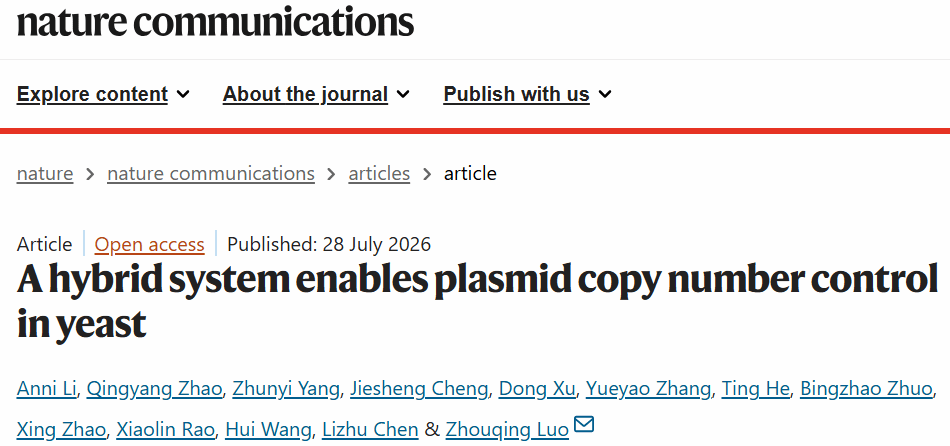
In this study, the Xiamen University research team bridges this long-standing technical gap by engineering a programmable PCN platform for yeast based on the endogenous 2μ plasmid. The resulting p2μ-Cir0 system combines high copy number (up to 20 copies per cell), improved population homogeneity, and robust segregation stability, supporting protein expression levels up to 56-fold higher than those achieved by a single chromosomal integrant. By introducing a centromere element into the p2μ backbone, the team constructed the programmable YTp-C and YTp-I systems, which enable efficient, time-dependent induction of PCN transitions from 1 to 38 copies. Further integration of Leu2d-mediated metabolic selection modules into the YTp-CL and YTp-IL variants elevates the maximum achievable PCN to nearly 70 copies, boosting overall expression capacity to approximately 110-fold relative to standard single-copy chromosomal integration. These engineered platforms collectively enable controlled transitions between distinct copy-number states while preserving exceptional genetic stability across extended cultivation passages.
To validate real-world utility, the team deployed this platform across multiple practical application scenarios. It enabled systematic phenotypic characterization of tRNA overexpression, and significantly enhanced the biosynthesis efficiency of high-value compounds including the therapeutic GLP-1 peptide precursor, natural flavor 2-phenylethanol, functional pigment β-carotene, and high-activity antioxidant ergothioneine. The system also unlocked a unique "storage-production" switch strategy for industrial strains: engineered strains can be maintained in a low-copy state for long-term cryopreservation, and then rapidly induced to a high-copy state once revived for bioproduction, improving long-term strain preservation viability by up to 20-fold.
Professor Zhouqing Luo from Xiamen University is the corresponding author of this study. Anni Li, Qingyang Zhao and Zhunyi Yang are the co-first authors of the paper. This research was financially supported by the National Key Research and Development Program of China, the National Natural Science Foundation of China, and the Natural Science Foundation of Fujian Province. A related patent application (No. CN202411825285.2) has been submitted to the China National Intellectual Property Administration.