Peptides and small proteins (<50 amino acids) play pivotal roles in cellular signal transduction, immune defense, and metabolic homeostasis, with evolutionarily conserved subgroups being particularly important. Combining high specificity, strong bioactivity, and low immunogenicity, peptide drugs offer the advantages of both small molecules and biologics; over 60 have been approved for treating diabetes, cancer, infectious diseases, and rare diseases. However, in-depth analysis of peptide–protein interactions (PepPI) remains significantly challenging: peptides are highly flexible in conformation, with binding interfaces that are shallow, transient, and dominated by weak interactions, making quantitative affinity measurement and interface localization difficult. Experimental methods suffer from low throughput and high costs, hindering large-scale application; existing computational methods also lack the ability to quantitatively resolve binding interfaces and affinities.
Recently, a research team led by Professor Zhiliang Ji from the School of Life Sciences and Professor Chen Lin from the School of Informatics at Xiamen University published a research paper in Nature Machine Intelligence, introducing a deep learning framework named VITAL. This study follows the core logic of “sequence–structure–function”: sequence determines structure, structure determines interaction, and interface residue relationships determine binding strength.
VITAL is a deep learning framework based on synergistic sequence–geometric dual channels, integrating qualitative prediction, interface localization, and strength quantification of PepPI into a unified analytical solution. The core innovations of this framework are manifested in three dimensions:
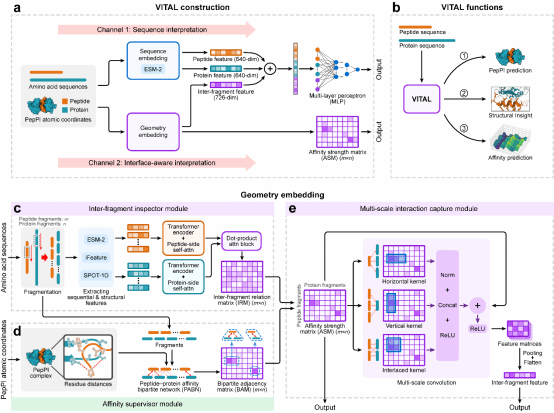
1. Significantly improving PepPI prediction accuracy to achieve state-of-the-art performance across diverse benchmark tests. The research team constructed a high-quality benchmark dataset; VITAL consistently outperforms existing mainstream methods across multiple independent test sets while maintaining robust performance under imbalanced sample conditions. With limited protein–protein interaction (PPI) data augmentation, it also matches specialized PPI predictors, demonstrating strong transfer potential.
2. Achieving near-residue-resolution mapping of binding interfaces. VITAL’s intermediate output, the Affinity Strength Matrix (ASM), can be directly utilized for binding site mapping. The VITAL-DeSite algorithm developed by the research team has been validated on extensive structurally resolved data, enabling accurate identification of both primary binding sites and potential secondary ones.
3. Establishing a binding strength metric significantly correlated with experimental data. The research team proposed the Binding Strength Unit (BSU), which shows significant correlation with experimentally measured binding free energy and bioactivity. Further analysis reveals differences in binding characteristics between single-site and multi-site complexes, collectively supporting the validity of BSU as an effective binding strength metric.
At the drug application level, VITAL’s predictive power was further validated. Targeting 64 FDA-approved peptide drugs, the method successfully recovered 90 of 106 known interactions. Through pharmacological network analysis, it recapitulated existing drug–target–disease associations and uncovered potential new targets and indications. Additionally, it identified off-target proteins associated with known adverse reactions, offering valuable insights for safety assessment.
Professors Zhiliang Ji (School of Life Sciences) and Chen Lin (School of Informatics) at Xiamen University are the corresponding authors of this paper. Ph.D. student Weihao Chen, master’s student Qiwen Wang, and master’s student Zhiyi Li are co-first authors. Ph.D. student Songyang Li also made important contributions to this study. This research was supported by the National Key Research and Development Program, the National Natural Science Foundation of China, and the Natural Science Foundation of Fujian Province.
Article link: https://www.nature.com/articles/s42256-026-01291-z
