Alveolar echinococcosis (AE) is a life‑threatening zoonotic disease caused by the larval stage of Echinococcus multilocularis. The parasite exhibits infiltrative, tumor‑like growth within the liver and carries a high mortality rate. It represents a major public‑health priority for prevention and control in China. Parasite growth persistently triggers host immune‑inflammatory responses, leading to substantial accumulation of reactive oxygen species (ROS) within the lesion microenvironment. Previous studies have shown that E. multilocularis can tolerate and exploit the host oxidative microenvironment to boost its proliferation. Nevertheless, the mechanisms enabling the parasite to adapt to this oxidative stress and sustain parasitic survival remain poorly understood.
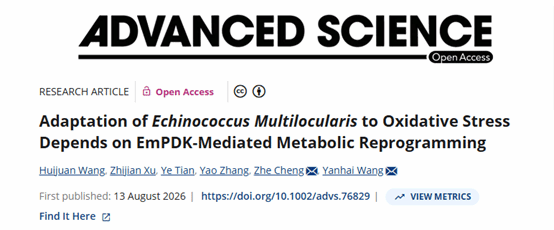
Recently, the research team led by Associate Professors Wang Yanhai and Cheng Zhe from the School of Life Sciences, Xiamen University, has made significant advances in understanding oxidative stress adaptation via metabolic reprogramming in this parasite. The study for the first time elucidates the core molecular mechanism underlying how E. multilocularis responds to host oxidative stress and identifies the key EmPDK‑dependent signaling axis governing metabolic reprogramming. The related work, entitled “Adaptation of Echinococcus multilocularis to oxidative stress depends on EmPDK‑mediated metabolic reprogramming”, has been published in the international journal Advanced Science.
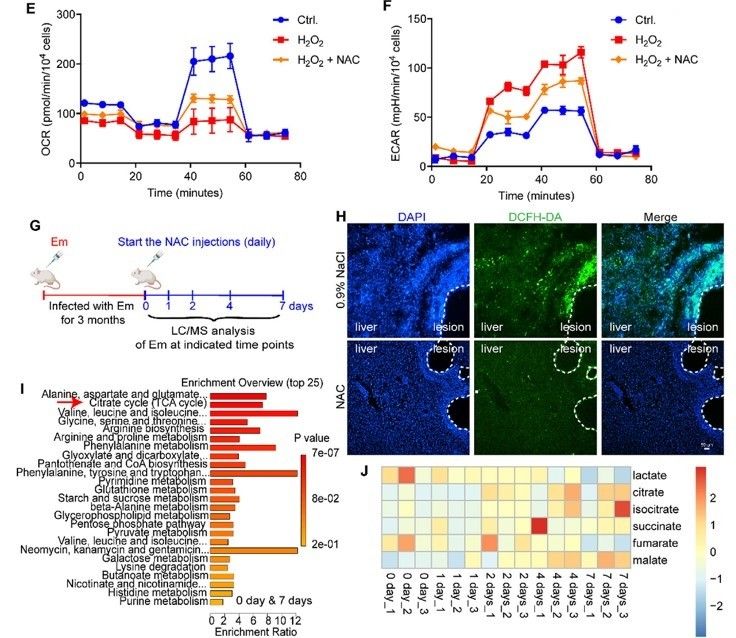
Using metabolomic analyses, the research team demonstrated that oxidative stress triggers metabolic reprogramming in E. multilocularis, diverting glucose flux from oxidative phosphorylation toward glycolysis. Further mechanistic investigation focused on EmPDK, a key metabolic kinase of the parasite. The results verify that host‑derived ROS in the microenvironment up‑regulates EmPDK expression via EmHIF1α, establishing a conserved ROS/EmHIF1α/EmPDK regulatory axis. This signaling cascade suppresses mitochondrial oxidative phosphorylation in the parasite, activates the glycolytic pathway, promotes lactate accumulation, and remodels the parasite’s energy‑metabolism profile. In vitro and in vivo experiments confirm that EmPDK is an essential molecule for parasite resistance against oxidative stress and proliferation. Inhibition of EmPDK reverses the parasite metabolic phenotype and markedly arrests parasite growth. In contrast, oxidative‑stress‑driven overexpression of EmPDK sustains enhanced glycolysis and supports stable invasive growth of the parasite within the host microenvironment.
This study revises the conventional view that parasites passively endure host adverse conditions. Instead of merely defending against host‑derived oxidative damage, E. multilocularis actively senses host ROS signals and achieves adaptive survival regulation through metabolic reprogramming. By enhancing glycolysis, the parasite reduces endogenous ROS production, alleviates self‑inflicted oxidative damage, improves tolerance to oxidative stress, and ensures proliferation and survival under oxidative challenge. ROS intervention experiments confirm that host oxidative stress acts as the upstream trigger initiating this metabolic reprogramming. This work establishes a working model of “host oxidative stress — parasite metabolic reprogramming — parasitic survival”, enriches the theoretical framework for parasite metabolic adaptation to host stress, and fills research gaps regarding metabolic regulation in E. multilocularis. It also provides valuable references for subsequent pathogen‑biology research and therapeutic‑intervention development against alveolar echinococcosis.
The first author of the paper is Wang Huijuan, a PhD candidate at the School of Life Sciences, Xiamen University. The co‑corresponding authors are Associate Professors Wang Yanhai and Cheng Zhe from the same institution. This research was supported by the National Natural Science Foundation of China, the NHC Key Laboratory of Echinococcosis Prevention and Control, and the National Parasitic Resources Center, and the Ministry of Science and Technology fund.
Paper link: https://advanced.onlinelibrary.wiley.com/doi/10.1002/advs.76829
