Recently, the research team led by Professor Huang Hongling from the School of Life Sciences and Xiang’an Hospital of Xiamen University published a study in the international immunology journal Immunity, titled “Krüppel-like factor 2 programs early exhausted T cell states and restrains antiviral immunity.” This study reveals a novel mechanism by which the induction of T cell exhaustion programs during early chronic viral infection enhances antiviral immunity.
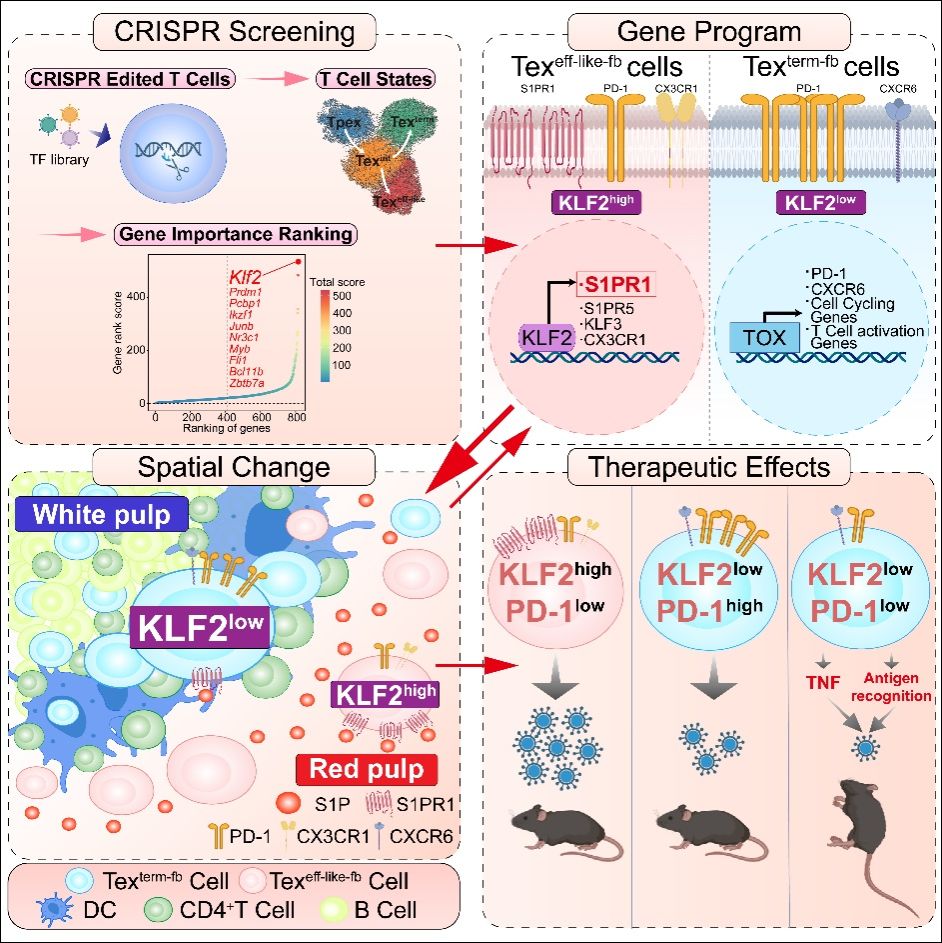
In this study, the team first established an in vivo CRISPR screening system suitable for investigating T cell fate differentiation during chronic infection. The results demonstrated that KLF2 is critical for the differentiation of the CX3CR1+ effector-exhausted subpopulation. Although recent studies have indicated that transcription factors such as T-bet and Batf are involved in regulating the generation and maintenance of the CX3CR1+ cell subset, overexpression of these factors failed to induce naive T cells to differentiate into the CX3CR1+ state. In contrast, KLF2 overexpression alone achieved this differentiation, highlighting the unique and critical role of KLF2 in this regulatory process.
At the functional level, early KLF2 deletion redirected cells that would otherwise differentiate into the CX3CR1+ effector-exhausted subset toward a CXCR6+ terminally exhausted state. However, this transition was not accompanied by a loss of antiviral function. Instead, KLF2 deficiency promoted the accumulation of antigen-specific T cells and enhanced anti-infection immunity. Mechanistic studies revealed that KLF2 deficiency altered T cell tissue localization, causing them to migrate into dendritic cell-rich areas, where they received stronger proliferative signals. Further experiments confirmed that blocking this localization change reversed the enhanced anti-infection immunity induced by KLF2 deficiency. Notably, the enhanced anti-infection immunity resulting from KLF2 deficiency was not associated with the significant pathological damage often observed with other immunostimulatory strategies, and this process was primarily dependent on the upregulation of PD-1. Collectively, these findings provide important new insights into the physiological significance of T cell exhaustion.
Recently, several independent research teams have successively reported that, in addition to its classic role in regulating T cell migration, KLF2 also plays a key role in the fate determination of CX3CR1+ T cell subsets. These findings have been published in journals such as Science, Nature Immunology, Immunity, and PNAS, highlighting the significant attention this biological process and scientific discovery have attracted in the field.
Professor Huang Hongling of Xiamen University is the sole corresponding author of the paper. Doctoral students Geng Shengjun and Li Zifeng from the School of Life Sciences of Xiamen University are the co-first authors. Several members of Professor Huang’s research group participated in this study. The work was supported by collaborative efforts from multiple teams, including those of Professor Jiang Yajun at Nanjing University, Xiamen University, Xiamen Medical College, and the affiliated hospitals of Xiamen University.
Link:https://www.sciencedirect.com/science/article/pii/S1074761326001408
