Professor Yong Cui’s team discovers a plant-unique transport vesicle derived from the multivesicular body and reveals its biogenesis mechanism
Recently, the team led by Professor Yong Cui at Xiamen University, in collaboration with Professor Liwen Jiang’s team at The Chinese University of Hong Kong and Professor Wilson Chun Yu Lau’s team at The Hong Kong Polytechnic University, published a research article in Nature Communications entitled “SNX-mediated biogenesis of a plant-unique vesicle derived from the multivesicular body.” Using a combination of correlative light and electron microscopy, three-dimensional electron tomography, cryo-electron microscopy, and all-atom molecular dynamics simulations, the study identified for the first time a plant-unique transport vesicle derived from the multivesicular body.
In eukaryotic cells, the endomembrane system maintains the ordered distribution of proteins and membrane components among different organelles through the coordinated action of anterograde and retrograde trafficking. Retrograde transport is essential for receptor recycling, organelle homeostasis, and the regulation of growth and development. However, in plant cells, the identity of the retrograde transport carrier responsible for recycling vacuolar sorting receptors (VSRs), as well as its subcellular localization, ultrastructure, and mechanism of formation, has long remained unknown.
To address this key scientific question, the research team used Arabidopsis thaliana as a model system and combined correlative light and electron microscopy (CLEM) with three-dimensional electron tomography (3D ET) to identify a class of spherical vesicles, approximately 30–50 nm in diameter, in the vicinity of multivesicular bodies (MVBs). Some of these vesicles remained connected to the MVB membrane, indicating that they are directly derived from MVBs. Further immunogold labeling experiments showed that these vesicles are enriched in retromer complex components, including SNX1 and VPS29, as well as VSRs, suggesting that they are likely the key carriers mediating retrograde transport in plants (Fig. 1).
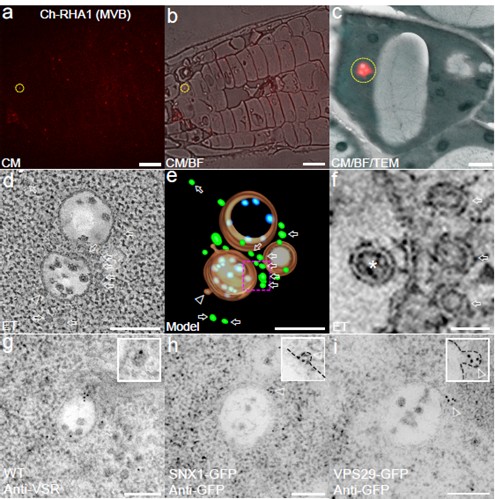
Figure 1. Budding of a plant-unique spherical vesicle from the multivesicular body in Arabidopsis root cells.
To elucidate the mechanism underlying their formation, the team further combined in vitro reconstitution, cryo-electron microscopy, and all-atom molecular dynamics simulations. The results showed that, after forming a heterodimer with SNX2a, plant SNX1 preferentially promotes the formation of spherical vesicles rather than long tubular structures, thereby revealing the structural basis and molecular mechanism underlying the biogenesis of this plant-unique retrograde transport carrier. Further cell biological and genetic analyses demonstrated that SNX1, SNX2, RAB5, RAB7, and the retromer core component VPS29 act together to regulate VSR localization and trafficking. This study reveals for the first time that spherical vesicles derived from multivesicular bodies are the core carriers of retrograde transport in plants, clarifies the molecular mechanism by which the SNX family mediates their biogenesis, provides a new theoretical framework for understanding endomembrane trafficking regulation in plants, and offers potential molecular targets for improving seed traits and stress resistance in crops.
Professor Yong Cui of Xiamen University, Professor Liwen Jiang of The Chinese University of Hong Kong, and Professor Wilson Chun Yu Lau of The Hong Kong Polytechnic University are the co-corresponding authors of the paper. Dr. Yanbin Li, postdoctoral fellow at the College of Life Sciences, Xiamen University; Ran Tao, PhD candidate at Xiamen University; Professor Hai Zhang; Xiaokang Wen, PhD candidate at The Hong Kong Polytechnic University; and Dr. Stephen King Pong Leung are the co-first authors. PhD candidates Qing Qi and Xiaohui Zheng, MSc student Haoxuan Guo, Assistant Researcher Congxian Wu and Professor Zhifei Fu of Fujian Medical University, and Associate Professor Xiaorong Huang of Xiamen University also participated in this work. This research was supported by the National Natural Science Foundation of China, the Natural Science Foundation of Fujian Province, and the President’s Fund of Xiamen University, among others.
Original article: https://doi.org/10.1038/s41467-026-71067-x
