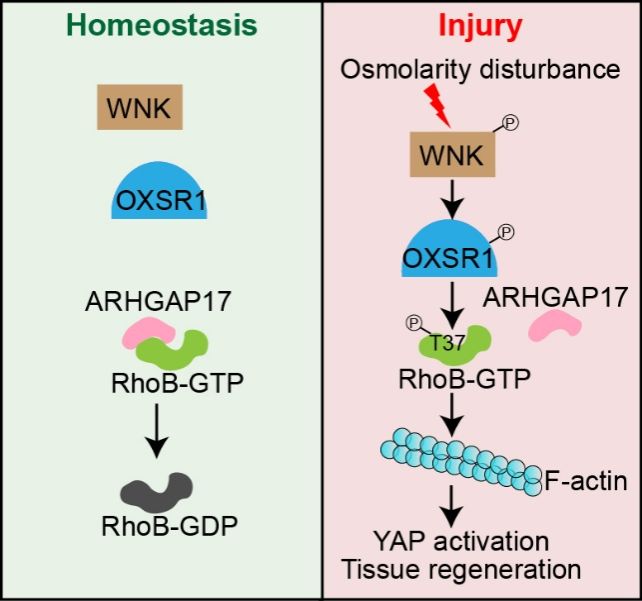
Abstract: Animals activate regenerative processes to repair injuries and restore homeostasis following tissue damage. A central question in regeneration is how damage signals are sensed and translated into regenerative growth. Tissue injuries lead to the release of intracellular contents and bodily fluids and disturb the osmotic balance. However, the role of osmolarity in regeneration remains largely unexplored. Using Drosophila and mouse intestine, as well as samples from inflammatory bowel disease (IBD) patients, we identify a key role for the osmolarity-sensing WNK-OXSR1 kinase cascade in intestinal regeneration. Mechanistically, OXSR1 phosphorylates the RhoB GTPase at threonine 37 upon intestinal injury, thereby disrupting its interaction with ARHGAP17 and increasing the levels of GTP-bound RhoB. RhoB activation in turn leads to enhanced F-actin polymerization and YAP activation, thus promoting tissue regeneration. We further show that pharmacological inhibition of WNK or OXSR1 reduces the oncogenic potential of intestinal regeneration. These findings reveal osmolarity as a critical damage signal in regeneration and position WNK-OXSR1 as a potential therapeutic target for stimulating intestinal repair.
Link: https://link.springer.com/article/10.1038/s44318-026-00738-8