Although bilaterian animals, including humans, exhibit an externally symmetrical body plan, many of their internal organs are arranged asymmetrically along the left-right axis. Moreover, the distribution of left-right asymmetric organs varies substantially among animal lineages. This contrast is particularly evident between amphioxus and vertebrates. In amphioxus larvae, asymmetric organs are primarily concentrated in the anterior pharyngeal region, whereas in vertebrates, left-right asymmetry is largely manifested in visceral organs. However, the developmental and evolutionary mechanisms underlying these striking differences have remained poorly understood. Over the last decade, Professor Guang Li’s team at the School of Life Sciences, Xiamen University, has systematically investigated the molecular basis of left-right asymmetry in amphioxus. Their previous studies have revealed that amphioxus and vertebrates share remarkably similar mechanisms to establish left-right asymmetry, both relying on a left-right organizer governed by a conserved gene regulatory network that includes Dand5. (PNAS, 2017; Development, 2017; Development, 2020; BMC Biology, 2021; eLife, 2024). However, the team noticed a fundamental difference between the two groups: the left-right organizer is located at the anterior end of the embryo in amphioxus but at the posterior end in vertebrates. Notably, this evolutionary shift in position, known as heterotopy, is closely associated with the distinct distribution patterns of asymmetric organs in the two lineages.
On May 19, 2026, the research team led by Professors Guang Li and Qingming Qu published a study in PNAS entitled “Regulatory rewiring of Dand5 drove left-right organizer heterotopy and organ asymmetry evolution in chordates”. By systematically dissecting the regulatory mechanisms underlying asymmetric Dand5 expression in amphioxus, the study revealed the molecular basis for the evolutionary relocation of the left-right organizer from the anterior to the posterior region of the embryo. These findings provide important insights into how the diversity of left-right asymmetric organs evolved across chordates.
Dand5 is the earliest known gene to exhibit left-right asymmetric expression in both amphioxus and vertebrates and occupies a pivotal upstream position in the left-right gene regulatory network. Previous studies in vertebrates have shown that Dand5 transcription is positively regulated by Notch and Wnt signaling, as well as by transcription factors such as Brachyury. In addition, vertebrate Dand5 asymmetry is established primarily at the post-transcriptional level through Bicc1-mediated asymmetric degradation of Dand5 mRNA, a process that depends on regulatory elements within its 3’-UTR. In the present study, the researchers found that amphioxus employs a markedly different regulatory strategy. Dand5 is directly activated by anterior Hedgehog (Hh) signaling and repressed by posterior Wnt signaling, and its asymmetric expression is established at the transcriptional level rather than through post-transcriptional regulation as in vertebrates. Importantly, the researchers discovered that although amphioxus Dand5 asymmetry is generated transcriptionally, its 3’-UTR already retains the ability to respond to Bicc1-mediated mRNA repression. In addition, Bicc1 itself is specifically expressed in the posterior region of amphioxus embryos. These findings suggest that key components of the vertebrate post-transcriptional regulatory machinery were already present in ancestral chordates and may be co-opted for regulation of Dand5 during vertebrate evolution.
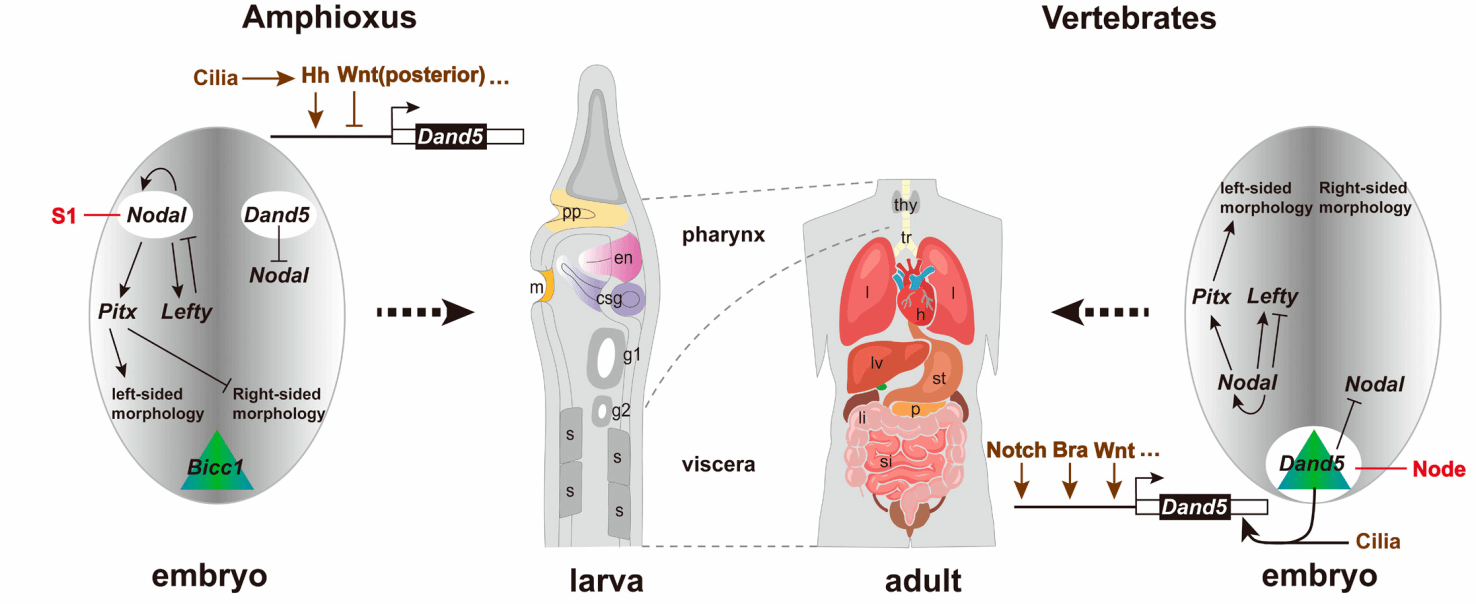
Based on these findings, the researchers propose that the evolutionary relocation of the left-right organizer from the anterior to the posterior region of the embryo did not require the invention of an entirely new developmental mechanism. Instead, it was likely achieved through the redeployment of pre-existing regulatory modules inherited from ancestral chordates. By altering where and when key regulatory genes are expressed, the left-right gene regulatory network was progressively repositioned to the posterior embryo, ultimately contributing to the emergence of the complex asymmetric organ systems characteristic of vertebrates. These findings provide a rare mechanistic explanation for how heterotopy can drive evolutionary innovation in animal body plans. More broadly, the study offers new insights into the evolutionary origins of complex vertebrate body plans and organ systems.
Rongrong Pan, a Ph.D. graduate from Professor Guang Li’s research group, is the first author of the paper. Former Master students Jiaqi Zou and Qiuning Yan, together with Yanhong Chen, a current Master student, also contributed to the work. Professors Guang Li and Qingming Qu from the School of Life Sciences, Xiamen University, are corresponding authors. This work was supported by grants from the National Natural Science Foundation of China, the Natural Science Foundation of Fujian Province of China, the Start-up funds from Xiamen University, and the Natural Science Foundation of Xiamen, China.
Article link: https://doi.org/10.1073/pnas.2531024123
